


Jamie Davis knows a thing or two about dealing with things that go bump in the night—and things that go wrong in the publishing business.
A former nurse turned prolific author, podcaster, and educator, Davis has spent his career helping people navigate the unexpected—whether that means treating patients, writing supernatural mayhem, or helping independent authors find their way through the increasingly complicated business of publishing. In addition to his contributions to the annual Author Nation conference, he hosts the Books and Authors Fantasy and Sci-Fi Podcast, where he interviews other authors to help with discovery. And he is a frequent guest on industry podcasts that educate new and emerging authors on marketing and platform-building.
Davis’s career is driven by his helper identity, and he says successful authors need to understand their own motivations. “It’s about finding the thing that drives you forward to keep getting the words,” he says.
Early Detection
Davis’s fiction career started unexpectedly. “While I was a nurse and paramedic, clinically, I had branched my nursing career into my original degree, which was in communications, and I became a nurse journalist,” he says. After ten years of traveling for medical conferences and doing interviews with keynote speakers, a colleague challenged him to try writing a novel for NaNoWriMo. “I was known for telling war stories,” he says. “It’s always fun to try to top the next guy.”
A lifelong fan of Urban Fantasy, he immediately drew inspiration from an experience he’d had several years earlier on a middle-of-the-night ambulance call with his partner. “We had a homeless gentleman who was particularly hairy that led us to a bunch of challenges doing his heart monitor and stuff like that,” he says. “And as we were riding back to the station after we had dropped him off at the hospital, I made a comment: What if that guy was, like, a werewolf or something? It was a full moon night. It was one of those things. Wouldn’t it be weird if that guy had been a werewolf?”
That first experiment led to an ongoing series of books about paramedics dealing with the paranormal. Looking back at other calls, he started to wonder what kind of mythical creatures other patients might have been. Davis prides himself on keeping the medical details realistic. “If the werewolf has asthma, they’re going to have asthma,” he says. “One of the highest pieces of praise I can get for my paramedic series is [that] I’ve had several people say to me, ‘You know, your main character, Dean Flynn, is the kind of paramedic I want to be.’ I can’t have any higher praise than that. I write him as an aspirational character for myself and the people I know,” Davis says.

Acknowledging that medical protocols vary by time and location, he includes a note in the back of his earlier books to alert readers to the fact “that these follow the Maryland medical protocols for paramedics this year. So some of the things that happen in the earlier books are no longer protocol. We have new medications and new treatment profiles for some of these things.”
Davis also tries to be respectful in the way he approaches sensitive subjects within the stories he tells. After working with a friend who dealt with PTSD, Davis wrote about his main character going through something similar. “That was magical in nature but still dealt with issues like not being able to work and not being able to face a patient for a variety of reasons. So I was very true to the process, even though there were some magical things happening along the way, because his problem was a magical problem,” he says.
His friend has since read the book and appreciated the way Davis depicted the experience. “And that one wrote itself,” Davis says. “There isn’t a paramedic out there who doesn’t know exactly what I’m talking about when I say cumulative trauma. And we all carry it with us. We all carry patients with us for the rest of our lives.”
Despite the sometimes challenging content associated with paramedical work, Davis’s books feature a strong focus on found family and other themes appropriate for young readers. “I try to keep it, you know, family friendly. And it’s nice because I hear from parents all the time that they can listen to my audiobooks with the kids in the car, or they can pass the book along to one of their teenagers. I like being that guy,” he says. “Yes, it’s Urban Fantasy, and there’s magic and all these things. But there’s often themes around the people that we surround ourselves with in our lives that influence us for good or bad and how we resolve that.”
Treatment Regimen
Early in his career, Davis pushed himself to write around his day job and family responsibilities, expanding his backlist to include both Fantasy and Sci-Fi subgenres. Now that he writes full time, he publishes four to six books per year, usually keeping them under eighty thousand words, which is expected for most Urban Fantasy novels. “In a normal workday,” Davis says, “I try to write one to two hours every day during the week. I take weekends off, most of the time.”
He said that treating writing like a job is the most important thing for writers to do. Davis believes in pushing through the difficult parts of the book, rather than taking a break or getting distracted by writer’s block. “I tend to write my way through those things until I figure it out,” he says.
“As we were riding back to the station after we had dropped him off at the hospital, I made a comment: What if that guy was, like, a werewolf or something?”
—Jamie Davis
Davis considers himself a pantser or discovery writer, and he writes chronologically. That said, he usually has an idea for how a book will end. “I like the big finish,” he says. “I see it in my mind. I’m very cinematic in how I see the words and see the scenes.” But he doesn’t often know how the characters will get there, and that’s what he enjoys most about writing. Although he may start out with a loose set of beats, he leaves room for the characters to surprise him. “It just takes a different route, and I go where the characters take me. The interesting thing is I always end up back at the ending that I saw in the very beginning.”
After writing straight through to complete the first draft, Davis uses ProWritingAid to do a rewrite pass, cleaning up the grammar before he sends it to his editor. “And then I have it edited by a professional—Jody Herlick. She’s fabulous,” he says. He found her through the Editorial Freelancers Association (EFA), after reviewing a few recommendations for someone with a style that matched his goals. Now, they have a routine where he submits new manuscripts to her every three or four months. “I think you have to respect people’s time. I’ve been late once, and I was late by five days. And I was horrified.”
Maintenance
One of the ways Davis holds himself to deadlines is by maintaining a regular work schedule, usually getting in his daily writing time each morning at the same café, Rise ’N Grind, in Rising Sun, Maryland. “I think a routine is important no matter where you write, whether you need total silence or you need the buzz of people around you. Having a routine is something that makes your brain get in the right mood. And if you set yourself up for success by having that routine, it can be good for you,” he says.
Building that structure was more challenging in his previous career as a journalist. “When I was on the conference circuit and doing a lot of traveling, I was just super busy,” Davis says. “I was writing a lot late at night or early in the morning.” He’s grateful that writing full time has given him the freedom to set a schedule that fits his family life and career goals.
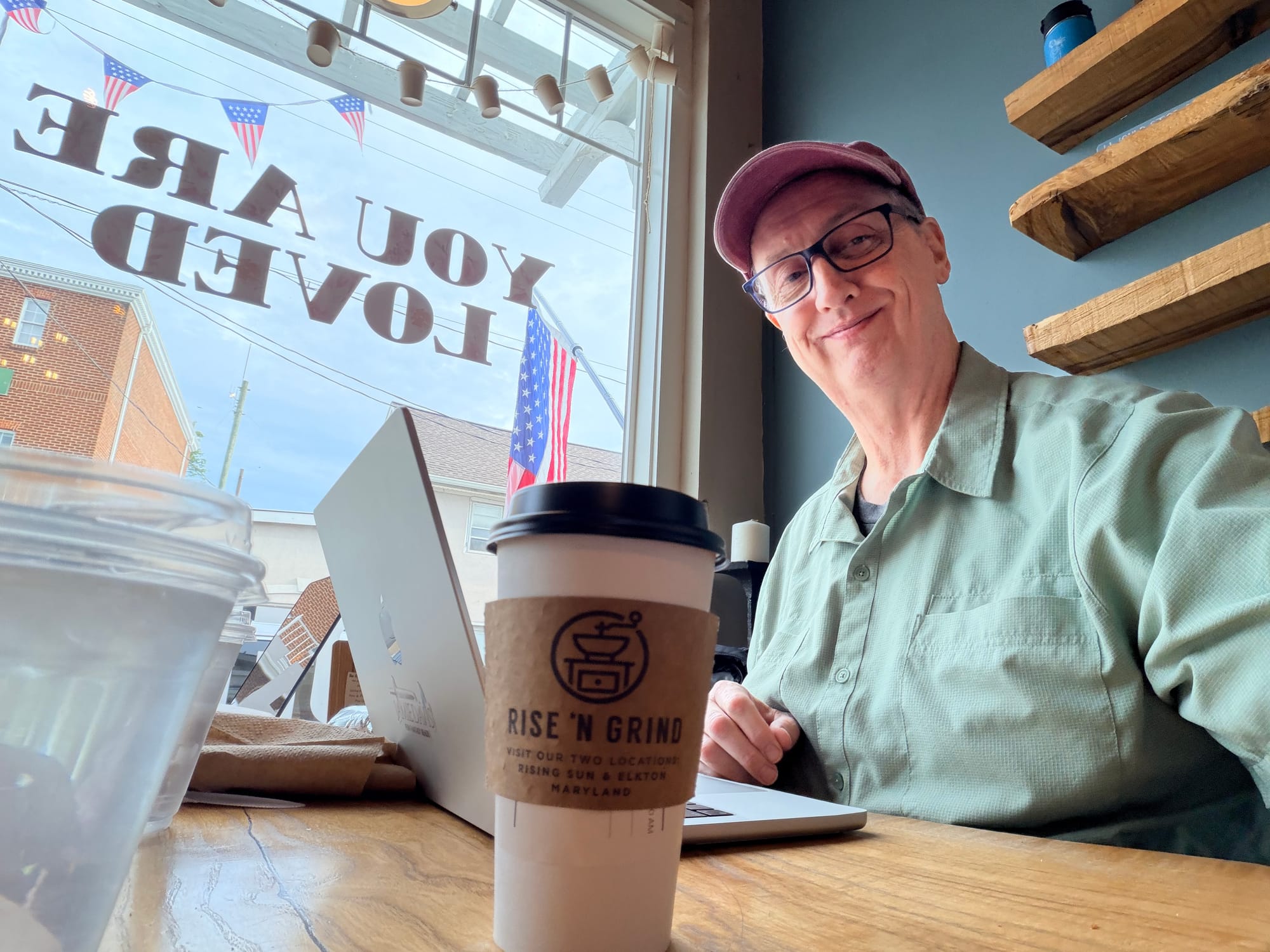
He’s been writing at Rise ’N Grind for years. “It’s just a delight,” he says. “They know who I am and what I do, and they’ll ask me where I am in the book. And I’ll tell them I’m close to finishing, or I just finished the book, and I’m getting ready to start a new one, and that kind of thing.”
Despite his friendships with the baristas, Davis isn’t quite the stereotypical author, tucked into a corner with an unending cup of coffee. “I’m a hot chocolate guy,” he said. That sweetness may come as no surprise, given the family-friendly themes of his books and his history of choosing careers that help others.
He isn’t alone in that mentality. Davis said his wife, Amy, has been very supportive of his work. “She has saved me from myself in a lot of my early stories,” he says. “She just has a very good sense for story, and she’s always been open to helping me with that. I’m very lucky to have a spouse who’s supportive and backs me up.”
Her support doesn’t end with Davis’s own stories, either. When Davis first started writing, his kids were in middle school. “Since I was working out of the house, essentially, as a journalist at that time, with several different podcasts that I recorded and things like that for healthcare professionals, I was the one that was doing a lot of that chauffeuring around and things,” he says. Now that the kids are older and he writes full time, however, the Davises have found time to help other authors. For the past five or six years, Amy has joined Jamie at Author Nation (formerly the 20Books Vegas conference).
“She comes to the conference. She helps out and volunteers at the conference every year. So a lot of people know who my wife is. Amy’s always there to help direct people to where they need to go and stuff,” he says.
Support Services
Davis said his involvement with the Author Nation conference started with its predecessor, the 20Books Vegas conference, created by Craig Martelle. Davis helped with the 20Books Vegas conference from its inaugural year in 2017 and acted as Martelle’s “lieutenant” in the 20BooksTo50K® online community from 2019 onward. “I offered to help out with the AV, and then that just kind of became more. As he needed more help with different things, I started picking up more and more of the slack,” he says.
When Joe Solari and his company took over the conference after Martelle stepped back, Solari asked Davis to help Author Nation retain some of the sense of service that drew authors to the original event—“which was high praise,” Davis says. He took the offer; he felt it was important to him to give back. “A lot of authors gave me opportunities by sharing my books with their list, or giving me ideas and pointers on how to make my writing better. All of these things happened because other people helped me.”
Today, Davis serves as the conference co-director of Author Nation. One of his priorities is to ensure that the Author Nation conference is aimed at authors of all levels. “We provide some VIP opportunities for the upper-level authors to get together and share information at a high level with each other, and in exchange for that, they share their information and knowledge base with the attendees,” he says. “You know, there are some things that a six- or seven-figure author does that you don’t need to know when you’re first starting out. They can tell you what it was they’re doing, but it wouldn’t make any sense to you because it’s another language almost at that level.”
Davis says the conference also attracts people who are in the middle of writing their first book. “They’re there for craft knowledge, and maybe about how to launch that first book,” he says. Davis encourages authors who may be in earlier stages of their careers to take advantage of the Mix and Mingle Midway, the area outside of the conference session rooms, where there are couches and tables and chairs, to sit down and have a conversation with authors they admire. “Be respectful, you know, have one or two key questions, and leave it at that. You can always come back and ask them next year, or the next time you see them,” he says.
“A lot of authors gave me opportunities by sharing my books with their list, or giving me ideas and pointers on how to make my writing better. All of these things happened because other people helped me.”
—Jamie Davis
The sense of community is one of the things Davis loves most about the conference. He says attendees should keep in mind that between panels, they may meet other authors who have already solved the problem they’re seeking to solve—even if it’s not a writing problem. ”We are writers, and we come from other careers and other jobs, and we bring a lot of collective experience in other realms of the world, too,” he says.
Almost ten years into helping with these annual conferences, three of those being for Author Nation, Davis continues to find new takeaways from the event. “I absolutely do learn from the conference,” he says. “The other side of it is I always meet new people. I always meet new authors. Those have become lasting relationships where we share each other’s joys and sorrows.”
This year, he’s particularly excited for one of those new authors to be the event’s keynote speaker, Andy Weir.
Prognosis
Davis credits his success as an author to a few early decisions. “I saw the business opportunity there and treated it like a business. I was intentional about the process I took. I sought learning early. I attended early conferences way before I might have thought I needed them because I knew there was information I was going to need before long to progress,” he says.

Although he doesn’t deny that some aspects of a writing career come down to luck, Davis believes being selective in the stories he chooses to tell has helped him find his audience. “I’ve also been very purposeful and intentional in picking new stories and new series to write in the hopes that that would be more likely to connect than otherwise. And that’s been successful for me, so I’ve carried forward,” Davis says. He recommends sharing a scene or a chapter with readers to encourage them to sign up for your newsletter. “The one piece of advice I give to writers early on is start building your email list immediately. Start finding your readers.”
Davis has built a career around helping people, first in the medical field and now in publishing, and his readers come back to find that same sentiment in his characters. Whether he’s writing about paranormal paramedics or cybernetically enhanced college students, his characters build communities and save lives.
And there are many more stories to come. “There is no shortage of stories running around in my brain,” he says. “I’ve had an overactive imagination that’s gotten me in trouble all through my school career growing up, and I finally found the reason that it was there, as an adult writing fiction stories.”


