


The Teaser
Today Deborah—pronounced “Deb-O-rah”—Wilde is the author of twenty-five novels, but before she began building magical worlds and a loyal readership, she was writing for the screen. She described her television work as “a mix of stuff” that included “a lot of Fantasy, especially animation.” But a career shaped by other people's productions eventually gave way to one built around her own stories, her own audience, and a signature voice.
Frustrated by an industry trend toward reality television, the Canadian screenwriter challenged herself to write five novels in three years. Deborah’s YA Rom-Coms, written under the pen name Tellulah Darling, featured sassy girls and swoony boys drowning in Greek mythology-inspired drama. She succeeded in publishing five of them between 2012 and 2015, and had written and published another by 2018. She loved it. But something was missing.
So she started again. When she reinvented herself a second time, this time as Deborah Wilde, the former screenwriter says she “jumped to Urban Fantasy that was very much for adults and spicy.” Her next four series starred snarky adult heroines solving high-stakes supernatural mysteries with open-door heat and salty language. And this time, she says, her characters could use “my favorite old Hollywood banter.”
The second shift was the answer she’d been looking for. Deborah is now an author of adult Urban Fantasy and Paranormal Women’s Fiction, written in four different series, released in three different formats, and translated into two additional languages, French and German. She has a fifth series debut novel up for preorder. Mad Queens Inc.: Golem For Broke leans into the success of her Magic After Midlife series, following the adventures of a wickedly competent heroine in her forties who runs an unlicensed magical problem-solving agency with her best friends.
But Deborah’s new persona isn’t entirely distinct from the screenwriter who took a risk. In fact, she says, starting over as Deborah Wilde allowed her to develop a persona that felt more authentic to who she really is: “a global wanderer and hopeless romantic” who is “also a total cynic with a broken edit button,” according to her website.
Act One: Setup
Reader interest guided Deborah’s transition from YA to New Adult stories, and the response to her Magic After Midlife series influenced her decision to develop her newest series around an older main character. “I am a Gen Xer, and we want our representation in Fantasy. So having an older heroine, even though she's not in her fifties, she's in her forties—the response has been amazing,” she says.
Deborah’s books are sources of representation in other ways, too. As a Jewish woman, she says that growing up, “the only books I ever saw myself in were Holocaust stories and those very important stories. But I wanted the Jewish girl who was going through the wardrobe or going down the rabbit hole, and there wasn't that.” So she developed her first adult series around Nava Katz, the Unlikeable Demon Hunter—a Jewish main character with a Jewish love interest.
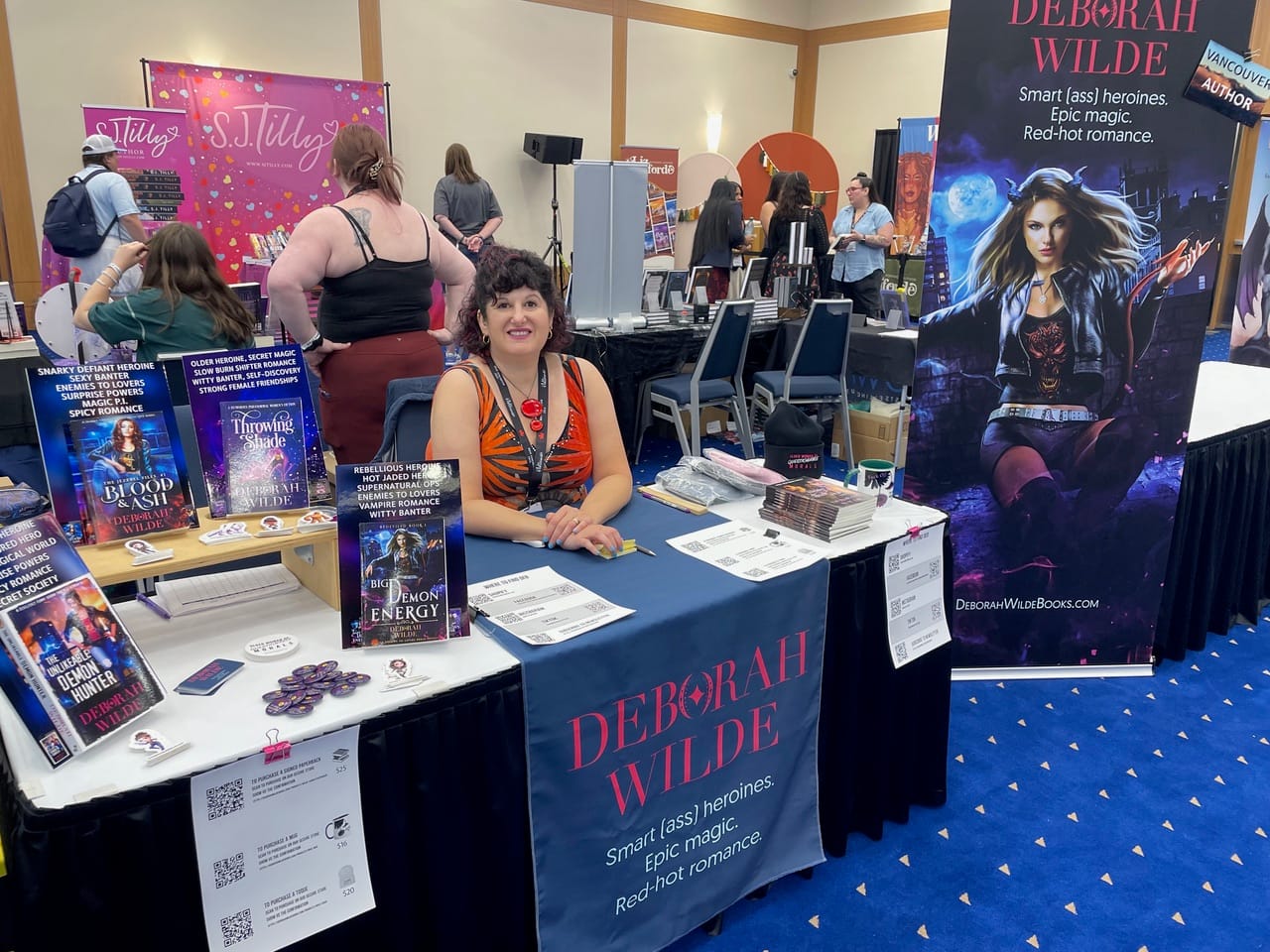
When asked about the skills that transferred over when she transitioned from screen to page, Deborah says, “What transfers over is structure. Writing dialogue is my happy place. I joke that I actually don't know how to write a book. I just know how to write a very long prose screenplay.” The biggest learning curve, coming from screenwriting, was adding description and character action. “The actors generally hate it if you tell them exactly what they're doing. And that was really hard for me,” she says.
The former screenwriter says that structure also led to her starting her author career as a plotter—though that’s since shifted. “Because of my screenwriting training, it was all nailed down,” she says. “And then I've just gotten really loose, and now I just have this sort of wonky hybrid where I'll know my first act.”
Although she described her day-to-day process as a mess, the writing system Deborah has developed for her novels now works for her. “I do a lot of thinking,” she says. “I count thinking and consuming other storytelling as part of my writing process.” Because all her series take place in separate universes, she says most of that thinking focuses on building each world: “What's the magic system? How am I building it? What is their personal problem? What's their backstory mystery that might follow them into this?”
When she starts to write, Deborah follows Becca Syme’s advice to avoid social media and other distractions. “I try to do it in the morning and really protect that time and not look at other stuff. It's like … it is my sacred time until I make my word count, and then [I’m] moving on to what else I have to do,” she says.
Perhaps unsurprisingly, she uses Save the Cat, a system that was built on screenwriting techniques, to develop the first drafts of her stories. Once the draft is done, Deborah takes the manuscript through what she calls “a really extensive editing process” with her editor. She’s worked with the same one for all twenty-five Deborah Wilde books. “I do two extensive developmental edits, really full rewrites,” she says. “Because for me, it allows me to get to the theme the way I want to and get to the depth of character development the way I want to. And then I do two line edits. A lot of it is punching up humor at that point, or maybe there's some pacing issues, and then it goes off to the proofreader.”
“I am a Gen Xer, and we want our representation in Fantasy. So having an older heroine … the response has been amazing.”
—Deborah Wilde
With the draft out of her hands, Deborah starts to think about the next book. She doesn’t keep a series bible. But she says, “I have a giant Word file that I just dump stuff in. And then with each book, I go back and go, ‘Oh, yeah, that. Oh, hey, look, I put that in two books ago! How clever of me. I didn't realize I'd need it.’” The books are published as she finishes them, and each series lasts until the characters “get to the end of their thematic journey,” however long that takes. Deborah says she can’t predict how long a series will go; some take five books and others six or seven. “I think the only series I ever knew for sure was my first one because it was seven books, and it was based around the seven deadly sins.”
Of course, she takes her readers’ interests into account, too. She extended the Jezebel Files series, which she had planned to finish with four books, because of reader interest. But when she felt the main character had “run out of story,” and readers still wanted more, she “created a cousin, who was, like, a nerdy magic scientist, and I put her in that world for two books,” says Deborah.
As her career has gone on, each new series has taken place in “different versions of Vancouver that have no connection to each other, so I am reinventing the magic system every time,” she says. Maintaining the connection to Judaism in her books has been a unique test, too. “In terms of magic mythology in Judaism and Jewish mythology or folklore, it's not like Greek and Roman, where there's so much. Or Celtic, where there's so much. So I sort of got to this fifth series, and I was like, ‘Huh, how am I including it this time?’”
Act Two: Confrontation
As she started writing books tailored to adults, Deborah found that her voice resonated so well with Gen X readers that she quickly built a community through her website, newsletter, and Facebook Group. “I just feel like this is what I can give them,” she says. “I can give them, you know, who I am.”
The peace she found in this community contrasted starkly with the stress of maintaining her Amazon rankings in Kindle Unlimited (KU). “It was not great for my mental health, always worrying about that,” Deborah says. So she left it behind. Deborah has now removed all of her books from KU and has no intention of ever going back, she says, though her books remain available for regular purchase through Amazon.
When she decided to take her books wide and try selling direct, Deborah faced a new set of challenges. “I had no idea how much work it would be,” she says. “I actually convinced my husband to leave his job in the film industry and come run it for me, and it is his full-time job. We have rebuilt the store probably three times.”

Deborah’s husband, Loreto, came from the post-production side of film and television. So while Deborah has had to adjust her writing skills from screenplays to manuscripts, his learning curve has revolved around technical work. “He knows a lot of the editing programs and a lot of things that have come in handy, but he still had to learn, and is still, because it keeps changing,” says Deborah.
Loreto took the lead with the online store, where the most recent revisions have included updating accessibility requirements and addressing generative engine optimization (GEO) to improve the site’s discoverability by chatbots—“because more people are using, say, ChatGPT to say, ‘How do I find a book?’ than necessarily Google,” Deborah says.
The store’s current incarnation is running through Shopify with some help from Bookvault and BookFunnel for distribution. “Shipping from Canada is a nightmare,” says Deborah. “We don't have media mail—it's really expensive.” So Bookvault handles her paperbacks in a print-on-demand system that also provides readers with a digitally signed option. Their shop merchandise is also handled by print-on-demand services.
Deborah’s About page on her website includes a blog full of book recommendations, a suggested reading order, and a helpful FAQ. After addressing questions about the genre and reader suitability, Deborah explains to her readers, “Why should I buy direct from your store?” The answer goes into cozy detail about her dream of owning a Victorian house with a bookshop inside before describing the perks of connecting with the author and the economic and logistical benefits to readers. Deborah says she put that entry into the FAQ for “the same reason that I wanted to sell direct. It was just another way to have a connection with my readers,” she says. “That's what's so appealing, you know? My readers have kept me going in my reader group, and in my newsletters when they respond to me, and with memes or just funny, snarky things back at me. So for me, direct sales was [a way that] I get to still have more of this one-on-one engagement with people.”
Act Three: Resolution
After testing her options and learning her boundaries, Deborah’s shop now works as part of a larger community. It’s an ecosystem built on wide releases that launch to her store two to three weeks ahead of other distributors. “I don't look at launches as a short-term thing,” she says. “I know I can make my backlist work for me. I know there can be longevity.” Deborah’s readers find her through Facebook ads that target her Magic After Midlife series and direct traffic to the shop. Back matter sends them to her newsletter, which introduces them to a Facebook reader group, where 1,900 readers discuss her work.
“It's been an enormous learning curve,” Deborah says, discussing the challenges of direct sales. “I don't regret any of it. I love being wide, I love having my own store, but I also know I am very fortunate to have somebody who can run it for me, because there's no way it would exist if it was on me.”
“I don’t look at launches as a short-term thing. I know I can make my backlist work for me. I know there can be longevity.”
—Deborah Wilde
For authors thinking about starting their own direct sales shops, Deborah says it’s important to remember that you can do it in pieces. “You don't have to do all of it all at once like I did,” she says. “Test it, you know: Start with your paperbacks, or start with your audiobooks if they're not exclusive to ACX, or try one thing and see how that goes.”
The next act in Deborah’s career will include her first Kickstarter campaign. Although she could have started small, that wouldn’t have matched the energy of her brand. “I didn't just decide, ‘Oh, it's my first one, let's just do a single volume.’ No, no. I did a three-omnibus set,” Deborah says. The set will include all seven of her Nava Katz: The Unlikeable Demon Hunter books. She’s nervous about fulfillment, since this will be the first product she plans to distribute herself from Canada rather than print-on-demand. “I hired a company to help me run it, but … for some reason, there's something about Kickstarter that I find so daunting,” she says.
If Deborah has learned anything from screenwriting, though, it’s that audiences come back for characters who keep evolving. Nearly thirty books into her publishing career, she’s still rewriting the script in real time. And the snarky voice that started as a screenwriter’s experiment continues to drive readers into the next story she writes—stories that, like her real life, feature strong, witty women over forty who take risks, face challenges, and find their own happily ever after.


