


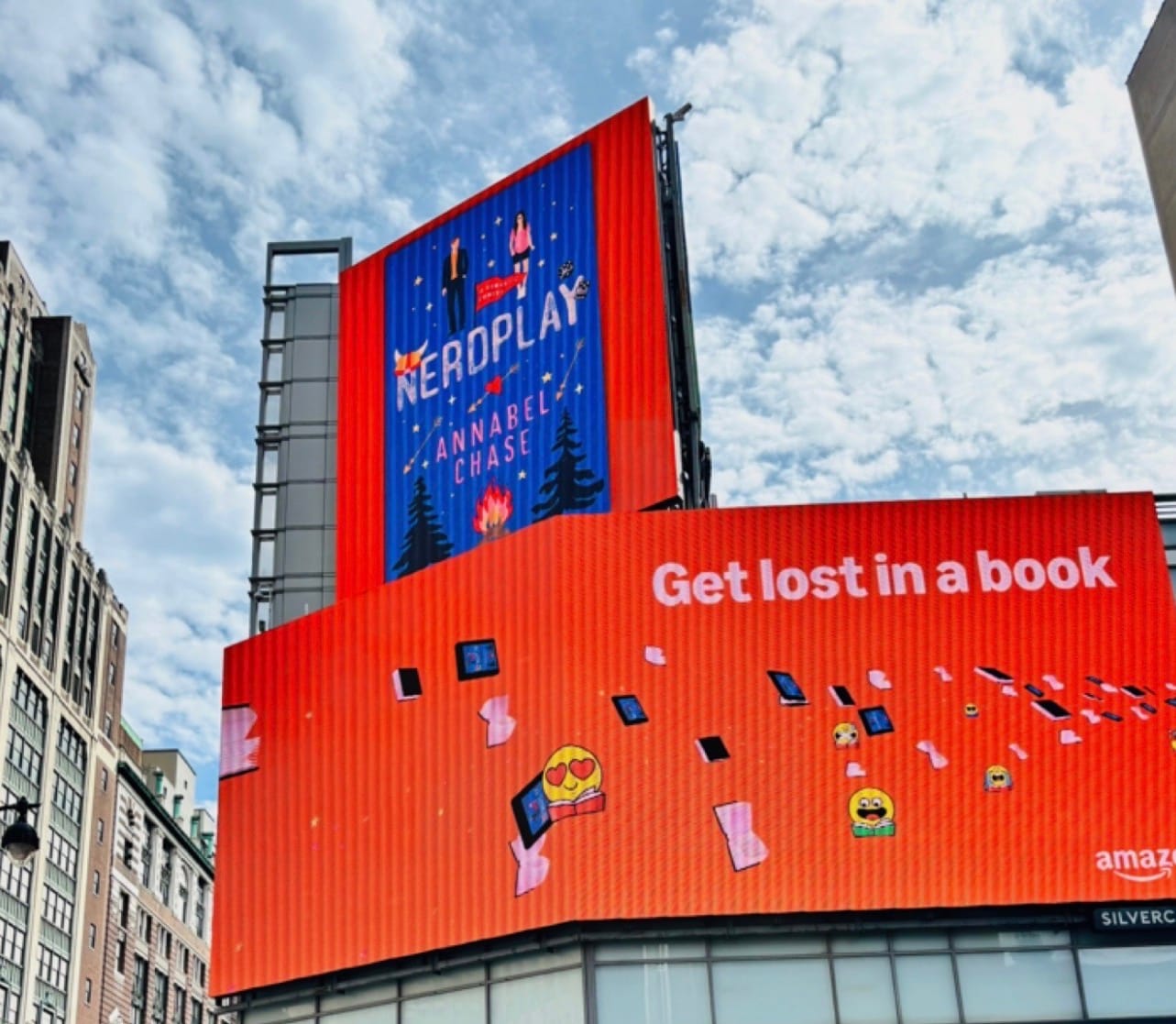
Annabel Chase has published more than 150 books across a dozen-plus series since 2011. She has thousands of ratings on Goodreads, an international readership, audio deals, a catalog deep enough to keep a binge reader busy for months, and a Times Square billboard under her belt. She’s heading to BookCon 2026 at the Javits Center this month alongside names like Cassandra Clare and Holly Black. By any measure, she’s one of indie publishing’s most prolific and commercially successful authors.
She’s also one you’d have a hard time picking out of a crowd—and she’d prefer to keep it that way.
In an industry that increasingly tells authors their face is their brand, Chase made a different bet. She runs TikTok content, buys ads, and markets aggressively—she’s as savvy as any indie author working today. She just made a deliberate decision about what gets the spotlight: the books, not her. And that distinction, fifteen years into her career, is looking more and more like a competitive advantage.
The Lawyer Who Became a Witch
Before she was conjuring magical towns and snarky heroines, Chase practiced law on two continents—she’s a dual citizen of the US and the UK. When asked which legal skills transferred to indie publishing, however, her answer had nothing to do with contracts or IP rights. It was all operations—“the ability to adhere to deadlines, even when I set them myself,” she says, or “an awareness of time—how long specific, repeated tasks take so I can plan accordingly.”
Operational discipline is the infrastructure behind a 150-book catalog. She knows how long it takes to write a book, how long to review and tweak her ads, and how to plan her production schedule so that she’s consistently feeding her backlist machine. To put into perspective just how much that discipline produces: She published all ten books of her Spellbound series between 2017 and early 2018, all while simultaneously launching the first Starry Hollow Witches novels. That production pace was calculated. In a genre where reader appetite is high and attention spans are short, Chase was stacking her catalog faster than most authors could outline one series.
It’s also worth noting the autobiographical echo in her most beloved series. The Spellbound books feature Emma Hart, a public interest lawyer drowning in student debt, who stumbles into a hidden supernatural town and discovers she’s a witch. The parallel is hard to miss—a lawyer who turns out to be better suited for a hidden world. “I think it was more wish fulfillment than reflective,” she says.
She went on to describe the wish fulfillment in more specific terms, listing what she called semi-universal desires: “being ‘special,’ discovering you’re more powerful than you realized, being accepted by your found family, and most importantly, finding Brew-Ha-Ha, a magic coffee shop that adds shots of whatever traits you need for the day.” That last detail is a big part of why readers can devour the twenty-six Starry Hollow books currently in the series—Chase builds worlds her readers want to live in and never leave.
And with the speed at which she’s churning out new books, she makes sure they never have to.
From Keeley Bates to Annabel Chase
Chase’s career didn’t start with the Paranormal Cozy genre, and it didn’t start under her current pen name. She began publishing in 2011 as Keeley Bates, writing Contemporary Fiction and Cozy Mysteries—her Saints & Strangers series earned an Honorable Mention in Library Journal’s 2016 Indie Ebook Awards. She also wrote under a Romance pen name, which she describes as doing “reasonably well”—a phrase that, in indie publishing, usually means paying the bills without building the career you actually want.
She describes those early years with the kind of fondness people reserve for chaotic origin stories. There was no strategy, she says. “It was just ‘look at this cool thing that allows me to publish my books and make some money.’” As the industry matured, she watched others forge new paths and started building her business more intentionally. She launched the Annabel Chase pen name, pivoted to writing Paranormal Cozy novels, and in 2017, she published Curse the Day—the first Spellbound novel and the inflection point of her career.
The pen name transition represented a moment of strategic clarity for Chase. Rather than trying to stretch an existing brand into a new genre, she started fresh with a name and identity built specifically around the kind of books she wanted to write for the next decade. She spent the following five years doubling down on Paranormal Cozy, stacking series like Starry Hollow Witches, Federal Bureau of Magic, and The Bloomin’ Psychic. Once the Annabel Chase brand had critical mass, she was able to bring older Urban Fantasy titles under the name as well, further consolidating her catalog.
Chase’s pattern—build a reputation in a defined lane first, then expand—was intentional, and it paid off. She’s now secure enough to publish a Contemporary Rom-Com or tackle a third-person, multi-POV series—a departure from her signature first-person voice—purely because the story demands it. “I have reached the point where I’m able to let myself do random stories just because I feel like it,” she says. A catalog built on depth has bought her that kind of creative latitude.
The Ecosystem: How the Catalog Feeds Itself
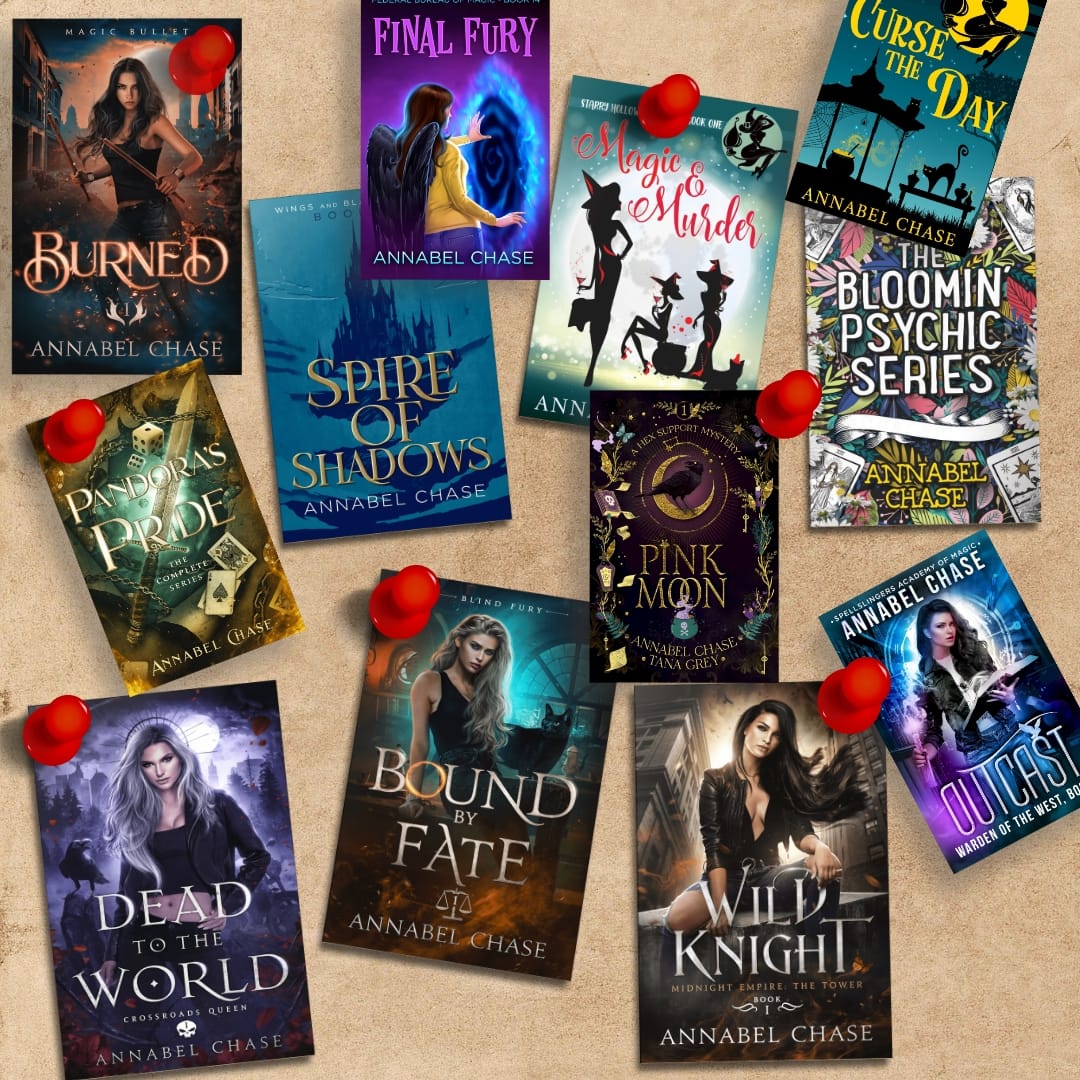
Chase’s series don’t sit in isolation. Spellslingers Academy is set in the same world as Spellbound, following the protectors of that universe as they train at school. Hex Support—a series co-written with Tana Grey—is a spin-off of Federal Bureau of Magic, which follows a retired agent. Starry Hollow exists in a different paranormal town from Spellbound but one that shares the same underlying mythology. The reader who finishes one series and wants more doesn’t have to leave Chase’s universe to find it.
The numbers behind this approach are proof enough that it’s successful. On Goodreads alone, Chase has accumulated over 313,000 ratings across 221 works, with a 4.37 average. Starry Hollow Witches, at 26 books, has more than 52,000 ratings. Crossroads Queen, a newer series with just nine books, has already crossed 52,000 ratings of its own. Federal Bureau of Magic sits at nearly 40,000 across fourteen books.
“I have reached the point where I’m able to let myself do random stories just because I feel like it.”
—Annabel Chase
Rather than chasing trends or scattering across unrelated genres, Chase built a network of interconnected series with overlapping worlds, consistent tones, and a core reader promise that holds across all of them: humor-infused supernatural stories with strong female leads. If a reader finishes one series and wants more, there’s always another door to open. Her backlist is designed to keep readers circulating within her ecosystem, and that seems to be exactly what they’re doing.
The Anti-Visibility Play
When I brought up the pressure for authors to become content creators and TikTok personalities, Chase didn’t mince words: “I actively dislike the push to be the face of your brand, especially in light of AI,” she says. “I would prefer my stories to speak for themselves without the need to become a hoop-jumping poodle for the internet’s amusement.”
To be clear, Chase markets. She markets hard. She runs ads and has a TikTok presence. The difference is that her ads and social content center her books and her worlds, not her personal life or her face. It’s a line that sounds simple to draw but requires real discipline to hold, especially when every platform’s algorithm rewards personal content over product content.
She acknowledges that timing helped. She built her massive backlist before TikTok and Instagram Reels became the dominant discovery channels, which gave her the financial cushion to be selective about how she showed up. The philosophy underneath is transferable, though: If your income comes from a deep, interconnected catalog rather than from personal-brand momentum, you’re far less vulnerable to platform shifts.
Many authors argue nowadays the value of a human face on camera is going up in light of AI-generated content flooding each platform, as a form of proof that there’s a real person behind the work. Chase sees it differently. She’d rather invest in the thing AI can’t replicate: a distinctive body of work with a consistent voice, and a universe readers return to because it feels like a specific person wrote it. Her approach won’t map perfectly to every author at every stage—a debut author in 2026 faces a different discovery landscape than Chase did in 2011. The underlying math still works, though.
Voice as Brand
If Chase’s face isn’t the brand, her narrative voice is. Across every series—Paranormal Cozy, Urban Fantasy, and even Contemporary Rom-Com—her protagonists share a recognizable DNA: They’re sharp, funny, slightly overwhelmed, and deeply human even when they’re casting spells or fighting vengeance demons. The archetype was somewhat market-driven, somewhat personal, she admits. “That style of storytelling suits my voice and seems to land with readers, so it was a win-win,” she says.
Pick up a Starry Hollow book after finishing Spellbound and you’ll recognize the tone immediately. Same with Crossroads Queen and Federal Bureau of Magic. Chase’s voice is the through line—the connective tissue that makes the ecosystem work. A reader doesn’t need to know what Annabel Chase looks like to know they’re reading an Annabel Chase book within the first few pages. That kind of voice recognition is what most face-of-brand marketing tries to manufacture externally; Chase built it into the product itself.
“I actively dislike the push to be the face of your brand, especially in light of AI. I would prefer my stories to speak for themselves without the need to become a hoop-jumping poodle for the internet’s amusement.”
—Annabel Chase
She’s also honest about the fact that staying in that lane was a choice. Now she’s testing its edges, varying the point-of-view and narration style of her next book “because that’s what the story requires.” But when you have 150-plus titles generating backlist revenue, you can afford to experiment with one series without betting the business on it.
Worldbuilding as Philosophy
For someone who keeps herself out of the spotlight, Chase has a lot to say about community—she just says it through her fiction. “Community building and found family are important to me, and they’re a common thread through almost all, if not all, of my series,” she says. Her protagonists tend to start in isolation and then gradually integrate into the communities around them, becoming bridges that connect others. To her, they embody a simple philosophy: If you want to change the world, start with yourself.
It’s a message that feels strikingly similar to anyone who’s watched Chase navigate the indie author community over the course of her career.
Chase’s career illustrates a few principles that most indie authors already know intellectually but rarely execute with this kind of consistency. She started in a genre that didn’t quite fit, recognized the mismatch, and pivoted to a genre and pen name built specifically around her natural voice. She stacked series within that genre that cross-pollinated her readership through shared worlds and spin-off characters. She treated her catalog as an interconnected system designed for reader retention, and she invested in production velocity during the critical early years when the backlist advantage compounds fastest. Along the way, she made a bet that the work itself—not her personal visibility—would be the more durable brand asset.
With her newest series, Blind Fury, already releasing in 2026 and a BookCon appearance at the Javits Center April 18 and 19 on the calendar—she’ll be at Table G23—she’s showing no signs of slowing down. She is, however, showing zero interest in filming a “get ready with me.”
For indie authors caught in the exhausting cycle of content creation, personal branding, and platform anxiety, Chase’s career offers a different model: a body of work so deep and so well connected that it generates its own momentum. Her books are the amusement, she says, and she intends to keep it that way.
The 313,000 Goodreads ratings she has to her name suggest her readers agree.


