


Indie authors often joke that writing the book is the easy part. The real work begins after the manuscript exists—launch planning, newsletter management, direct sales, analytics, and the constant juggling of platforms required to keep a publishing business running.
Authors today can draft in Scrivener, track projects in Notion or Trello, format books in Atticus or Vellum, sell direct through Shopify or Payhip, schedule social media with Buffer or Hootsuite, and run newsletters through services like MailerLite or ConvertKit. The ecosystem is rich—but it’s also fragmented.
For many writers, the challenge isn’t access to tools but instead coordinating them. Every platform solves one problem while creating another: a growing stack of dashboards, logins, and data silos. As independent publishing grows more sophisticated, some developers are beginning to ask a larger question: What if authors had an operating system designed specifically for running a publishing business?
StorytellerOS enters this landscape with a broader approach; instead of specializing in one part of the publishing workflow, it attempts to bring many of them together in a single dashboard designed specifically for authors.
Note: StorytellerOS was created by Chelle Honiker, CEO and publisher of Indie Author Magazine. This article provides an objective overview of the platform’s structure and capabilities.
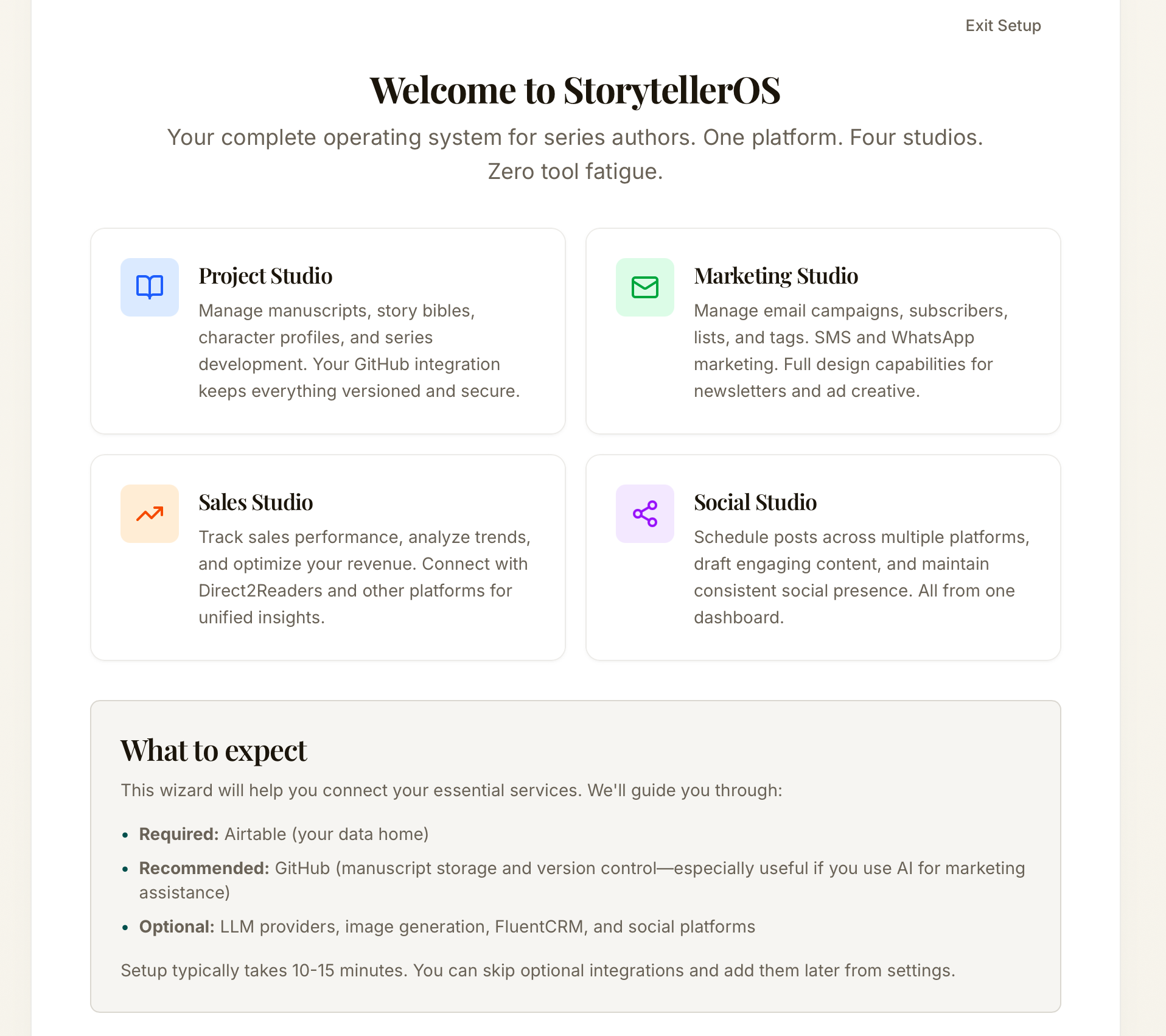
Created by IAM publisher Chelle Honiker, StorytellerOS is positioned as an operational hub for managing many aspects of an author business. Rather than replacing existing tools outright, it functions as a central workspace where writing, marketing, sales tracking, and administrative tasks can coexist. As a relatively new platform—the program entered beta testing in October 2025 and fully launches April 30—StorytellerOS is still evolving. But its design reflects a specific philosophy: that indie authors increasingly operate as small publishing companies—and may benefit from software built with that reality in mind.
From Tools to Infrastructure
The inspiration for StorytellerOS came from a familiar frustration among independent authors: the sense that managing the business side of publishing can overwhelm the creative side.
Honiker describes her own experience as a starting point for building the platform. “I used to start my morning every day the way most indie authors do,” she says. “I would bounce between Google Docs for my manuscript, spreadsheets for my launch checklist, Notion, Canva, my email platform for newsletters, KDP for my sales numbers, and by the time I'd gotten through all that, my actual writing time was gone.”
Instead of building another stand-alone application, Honiker attempted something broader: a dashboard designed to bring multiple aspects of the publishing workflow into one environment.
StorytellerOS sits within a network of author-focused brands developed or managed by Honiker’s company, Athenia Creative Services, over the past several years, including Indie Author Magazine, Indie Author Training, Indie Author Tools, Direct2Readers, Author Automations, and Wide for the Win. According to Honiker, these initiatives collectively reach tens of thousands of independent authors and involve a contributor network of more than eighty industry professionals.
StorytellerOS was designed to consolidate the lessons learned from these projects into a single system. Authors using the platform benefit not only from its foundation in the developer’s experience building these prior platforms but also from direct access to their courses and content, which are housed in the Knowledge Studio.
Rather than merely delivering information or training, StorytellerOS provides infrastructure as well—tools that support the operational side of running an author business. In practice, it functions less like a single-purpose app and more like an integrated workspace—think Notion or Airtable—preconfigured specifically for publishing tasks.
The platform organizes those tasks into five primary areas, called studios:
- the Project Studio, for writing and story development;
- the Marketing Studio, for email and audience communication;
- the Sales Studio, for revenue tracking and direct sales management;
- the Social Studio, for social media scheduling and campaign planning; and
- the Knowledge Studio, for documentation and education resources.
Supporting these studios are additional administrative tools for tasks, finances, and media storage.
Project Studio: Writing and Story Development
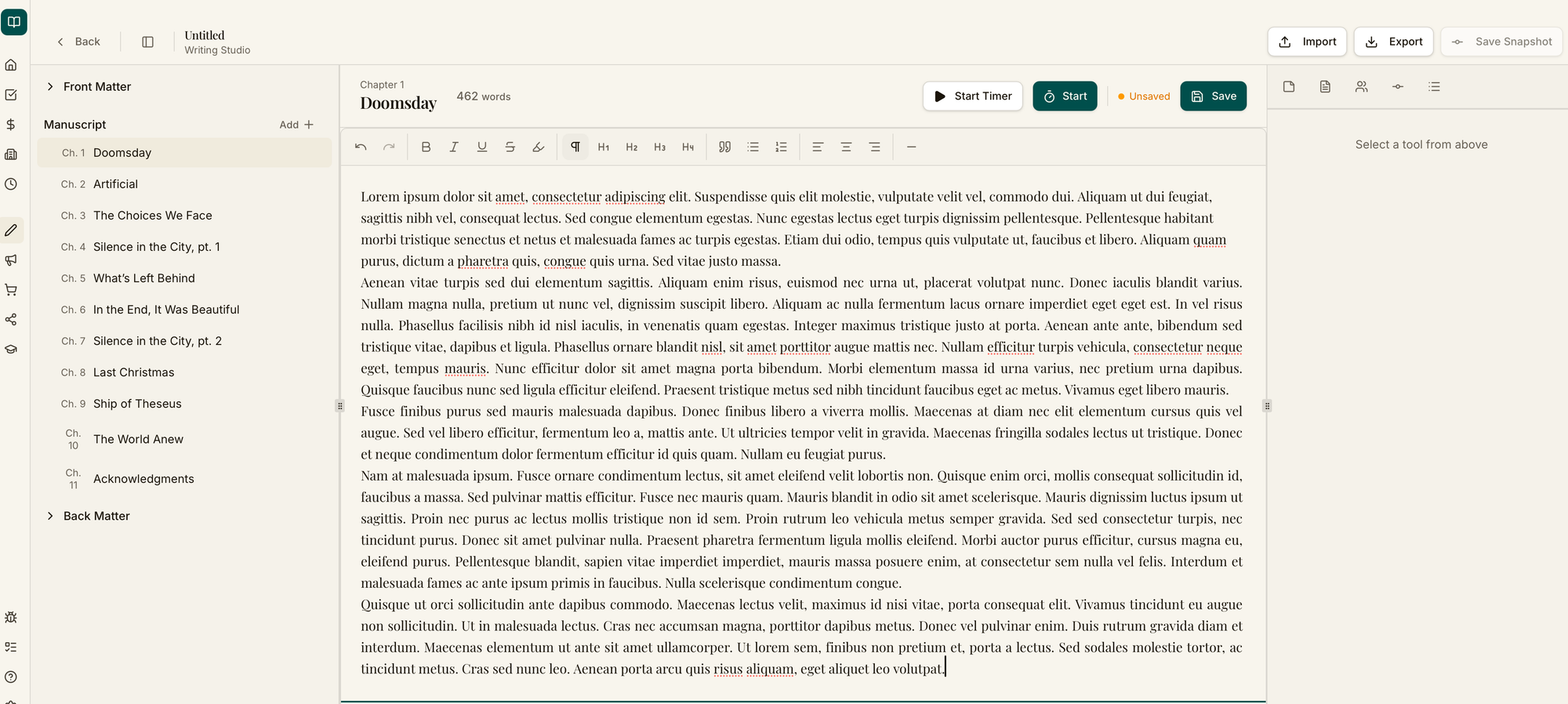
The Project Studio functions as the creative center of the platform. Its interface resembles a hybrid between familiar writing tools. The layout includes a manuscript editor, a navigation pane for chapters, and a set of project-management tools designed specifically for fiction and nonfiction development.
Authors can create projects for individual books or series, each with its own structured workspace.
Manuscript Drafting
The drafting environment includes:
- chapter navigation,
- word counts,
- scene notes,
- outline management, and
- export options.
Writers can also save snapshots of a manuscript version and revert to earlier drafts if needed. This version control approach mirrors features commonly found in long-form writing software.
A built-in timer allows authors to track writing sessions. The system supports traditional timers or Pomodoro-style intervals, with each session logged into a time tracker for later review.
Story Bible Tools
Beyond drafting, Project Studio also functions as a story database. Writers can create detailed profiles for characters, locations, events, world-building details, or other magic systems and fictional rules relevant to a particular project. Each element can be linked to books and series, allowing authors to check continuity details without leaving the writing environment.
Series and Pen Name Management
Independent authors often publish under multiple pen names or maintain several series simultaneously. StorytellerOS includes a structure for organizing both.
Users can create pen-name profiles and attach books, marketing campaigns, and financial data to each identity. During setup, the system offers both a quick-start option and a more detailed workflow that helps authors define brand elements for the pen name.
Marketing Studio: Email and Audience Management
The Marketing Studio focuses primarily on email communication and contact management. StorytellerOS integrates with several email platforms. Current and planned integrations include services such as FluentCRM, MailerLite, ConvertKit, ActiveCampaign, MailPoet, and Mailchimp.
Once connected, authors can keep their subscriber data in their chosen platform and use StorytellerOS as the interface to build, manage, and automate email campaigns.
One notable feature of integrating an email service provider with the platform is bi-directional synchronization. Data changes made in either system are mirrored in the other, reducing the risk of losing information if an author switches email providers later. The platform also maintains a backup of contact data through Airtable, providing an additional layer of redundancy in case an author’s mailing list is lost or deleted.
CRM Functions
Marketing Studio can also function as a lightweight customer relationship management (CRM) platform. Authors can store notes about individual contacts, track ARC teams or street teams, and send one-off emails without leaving the dashboard.
Blog Management
Another feature within the Marketing Studio is blog publishing for WordPress and Shopify sites. Authors can draft and manage posts within StorytellerOS before publishing directly to those platforms, keeping the management of these sites under the same roof as other marketing platforms integrated with the platform.
Sales Studio: Revenue in One Dashboard
The Sales Studio attempts to answer a common question in indie publishing: How much is each book actually earning across all channels?
Retailer dashboards typically display data one platform at a time. Authors selling through Amazon, Kobo, Apple Books, direct storefronts, and other outlets may need to check several systems to see a full revenue picture.
Sales Studio aims to aggregate those streams into a single view.
Within the studio, authors can connect:
- retailer reporting tools,
- Shopify or WooCommerce stores,
- direct sales listings, and
- analytics services such as Book Report.
The goal is a unified revenue dashboard showing total performance across multiple outlets.
Direct Sales Integration
StorytellerOS’s integration with Direct2Readers, a direct-sales discoverability storefront under Athenia Creative’s family of platforms, allows users the opportunity to host direct sales through Direct2Readers and manage them from within the platform.
Within StorytellerOS, authors can create product listings that appear on Direct2Readers and deliver ebook purchases to readers through BookFunnel; subscriptions to StorytellerOS automatically include a storefront listing on Direct2Readers. Readers can then browse books through a conversational search interface designed to help them discover titles within the catalog.
Social Studio: Managing Visibility
Maintaining an online presence can consume a significant portion of an author’s time. The Social Studio in StorytellerOS attempts to simplify this process with a central scheduling system. Authors can connect social accounts and manage posts across multiple platforms through a single calendar interface. Features include video creation, a visual content calendar, an AI campaign generator, AI image generation, and smart scheduling.
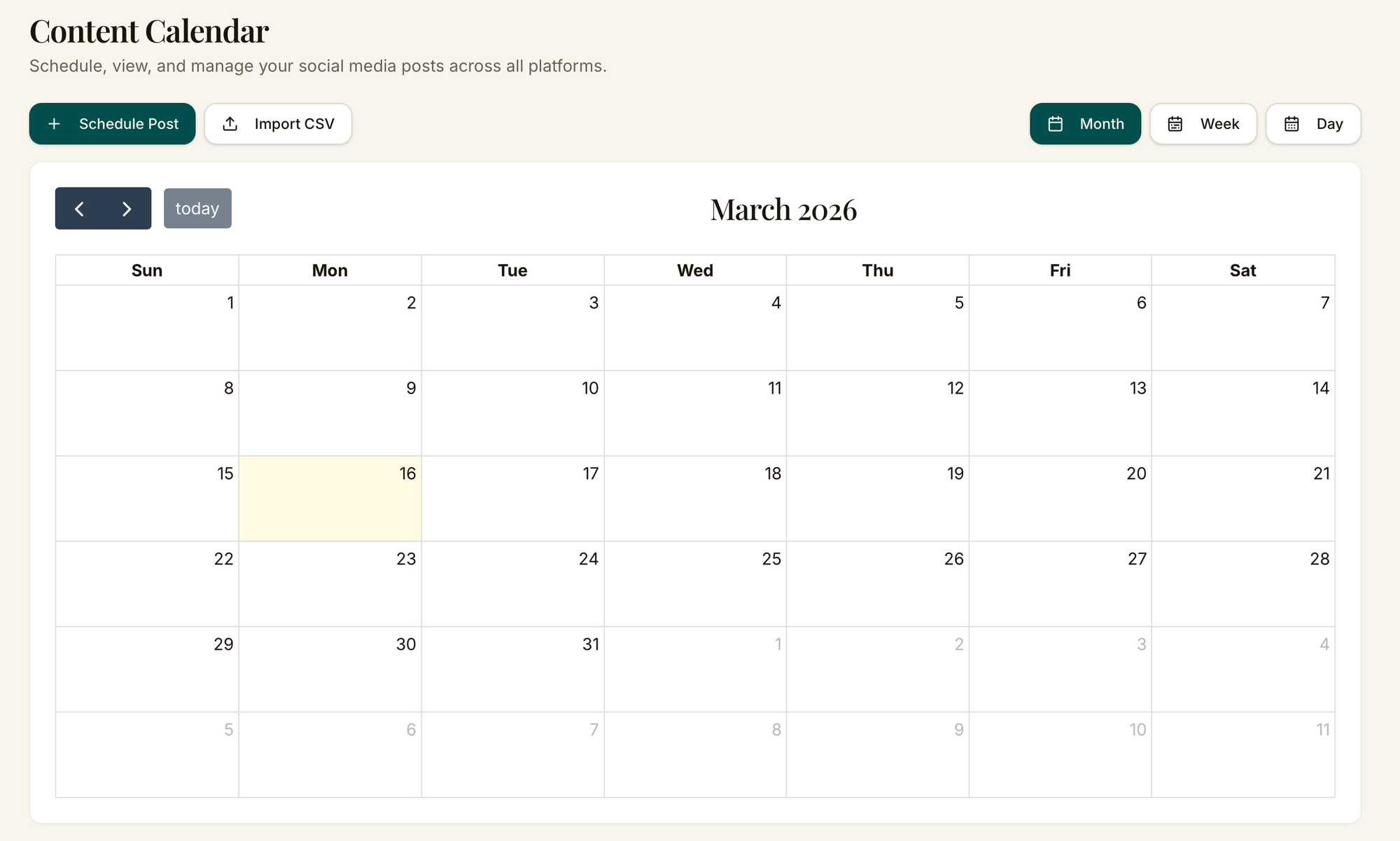
The system currently supports posting to a wide range of social networks, including: Facebook, Instagram, TikTok, Twitter/X, LinkedIn, Pinterest, Threads, Bluesky, YouTube, Reddit, and Google Business. If AI tools are enabled, Social Studio can generate promotional campaign ideas based on an author’s brand guidelines and book data. The system may suggest posts related to book launches, behind-the-scenes writing content, or book quotes, or it may suggest content specifically to encourage follower engagement. Authors can review these ideas, accept or reject them, and edit the resulting posts before scheduling them. They can also auto-reformat posts for multiple platforms.
Image prompts and captions can also be generated automatically, using Claude, ChatGPT, Gemini, or Freepik integration. However, like with other AI tools throughout the platform, the studio remains usable without AI features; authors can manually upload content and schedule posts just as they would in traditional social scheduling software.
Knowledge Studio: Built-In Education
The fifth studio, Knowledge Studio, connects users to learning resources.
Within this area, authors can access an extensive list of FAQs, including quick-start guides and troubleshooting articles for the platform, as well as recorded webinars from Indie Author Training and articles from Indie Author Magazine.
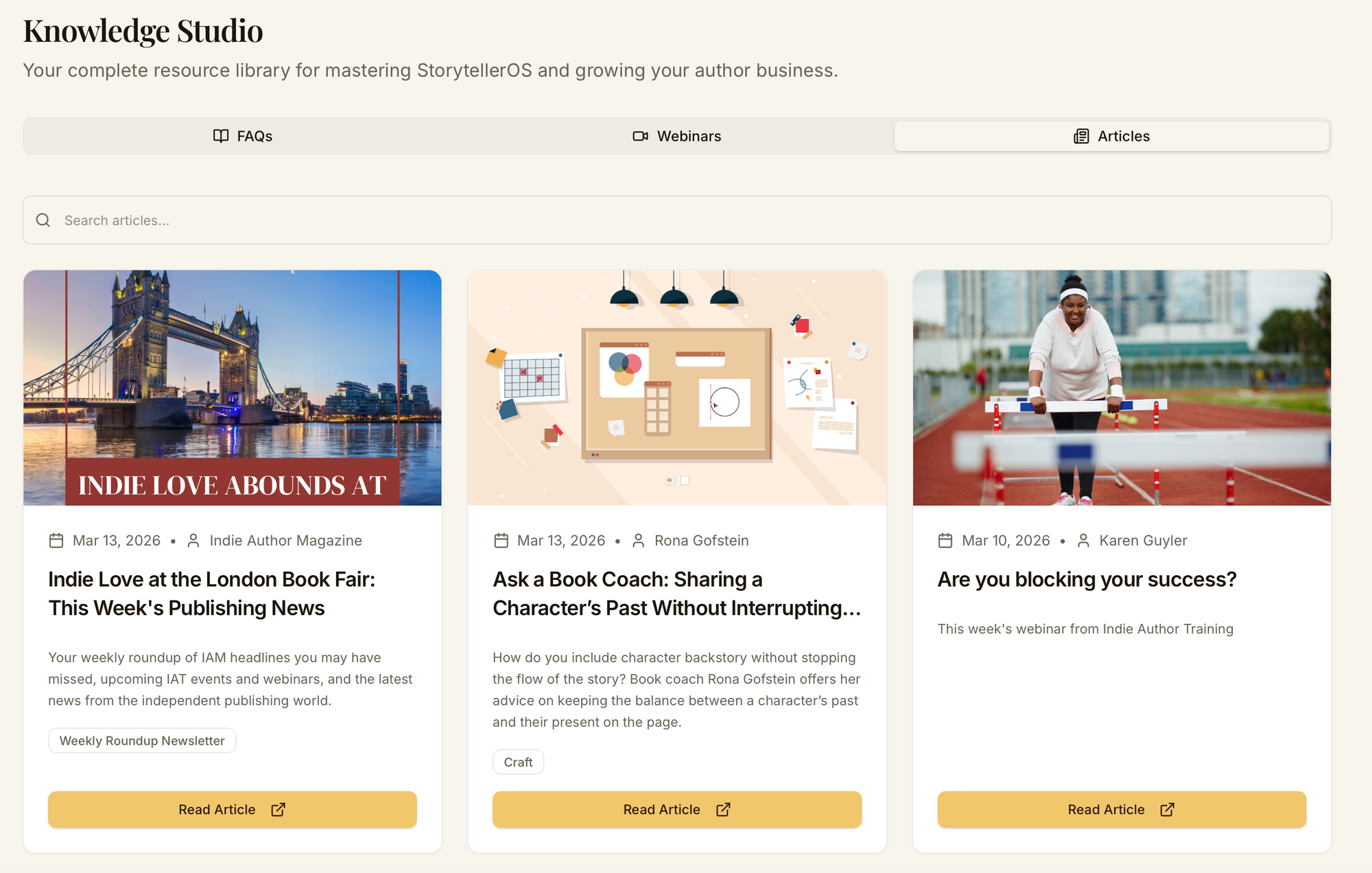
The integration turns StorytellerOS into both a workspace and a knowledge portal. Authors working inside the platform can reference tutorials or educational content without navigating to separate websites.
Administrative Tools
Beyond writing and marketing, StorytellerOS includes several tools intended to help authors manage the operational side of their businesses.
Task Management
A built-in task system allows users to track projects through multiple formats, including traditional task lists, calendar views, and kanban boards, similar to those on apps like Trello or Notion. Templates are also available for common workflows, such as book launches, marketing campaigns, or research projects.
Tasks can be attached to specific pen names, series, or titles, helping authors keep different publishing brands organized.
Finance Tracking
A simple financial tracker allows authors to log expenses and monitor payments. Entries can be associated with particular books or pen names, making it easier to calculate the cost of launching or maintaining each project. The system also allows users to track vendors, such as translators, editors, or narrators.
Although this tool does not replace full accounting software, it provides a centralized place to record business expenses alongside management of other administrative tasks.
Media and Data Storage
StorytellerOS includes a media library where authors can upload images and other assets and reuse them across different studios. Behind the scenes, the platform uses cloud services like GitHub and Airtable to store data and manage backups. This setup keeps all tools in sync while giving users easy access to their files.
AI Features: Optional and User-Controlled
Artificial intelligence plays a role in StorytellerOS, but it’s entirely an optional one. AI tools can be disabled through the settings menu. When disabled, AI-generated suggestions are removed, and users rely on the platform’s standard manual tools and search features.
“If I don’t want anything AI in my entire studio here, I can disable every AI feature and it’s all shut off,” Honiker explains in a demonstration of the platform.
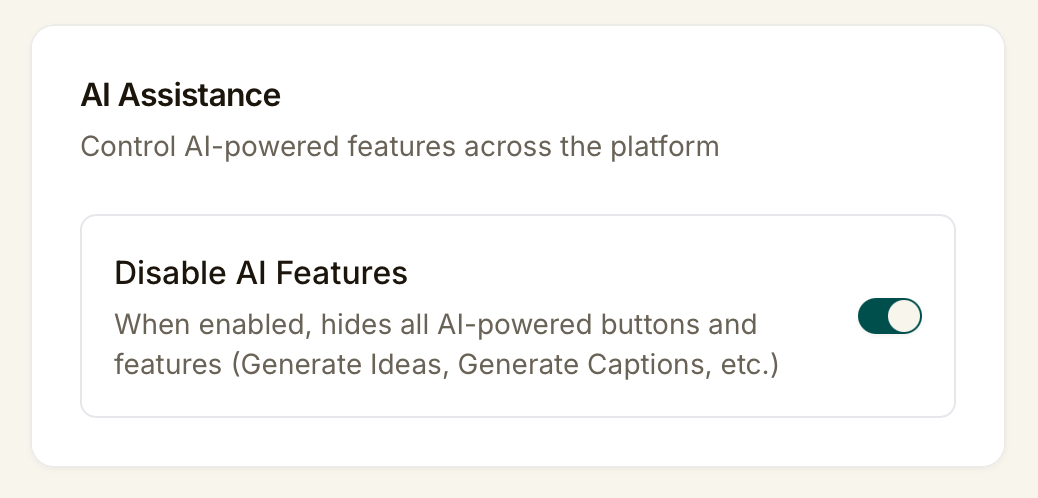
For authors who do enable AI, the system uses the technology less as a writing generator and more as a business assistant, for tasks such as generating brand guides for pen names, drafting marketing content, analyzing sales data, or suggesting newsletter campaign ideas.
StorytellerOS lets authors bring their own AI keys—from Claude, ChatGPT, Gemini, and more—so any requests go straight through the service they choose, not through StorytellerOS itself.
Comparing StorytellerOS to Other Author Tools
Because StorytellerOS spans several parts of the publishing workflow, comparisons with existing software depend on which feature set is being examined.
In terms of manuscript drafting and story organization, Project Studio shares similarities with writing tools such as Scrivener or Plottr, both of which emphasize structured story development.
The overall dashboard concept resembles productivity systems like Notion or Airtable, where users build customized workflows across multiple types of data. StorytellerOS differs, however, in that its workflows are pre-built for publishing rather than constructed from scratch.
Social Studio overlaps with social scheduling platforms such as Buffer or Hootsuite, and its Marketing Studio covers ground typically handled by email marketing systems.
Sales Studio’s integration with Direct2Readers places it within the broader conversation around direct sales infrastructure for authors, a space that includes storefront tools like Shopify as well as author-focused platforms.
The key distinction between StorytellerOS and its comparative platforms is that it aggregates each platform’s functions into a single environment rather than specializing in one.
Whenever a platform attempts to combine multiple tools into one system, a common concern arises: the risk of putting too many functions into a single environment. Some authors prefer specialized tools for each task. Others prefer the convenience of managing everything in one place. StorytellerOS attempts to address this concern by focusing on integration rather than replacement. Many of its features connect to existing platforms rather than requiring users to abandon them.
Still, the experience of using the platform will likely vary depending on how many of its tools an author chooses to adopt.
A Platform at an Early Stage
As with many newly launched platforms, StorytellerOS is still under active development. The company maintains a public roadmap where users can request features and view upcoming integrations. According to the website, dozens of updates have already been released since launch.
While StorytellerOS is still in beta, founding members can join for $149 per month with a seven-day free trial. Authors can cancel at any time through their account settings and will retain access until the end of the current billing cycle. There are no cancellation fees or long-term contracts. The price will increase to $249 per month once the program is out of beta—a price determined from the cost of separate social media, email marketing, and sales tools the platform replaces, according to the StorytellerOS website.
The platform also includes an affiliate program that provides recurring commissions for author referrals as long as the referred accounts remain active. For more information, contact affiliate@storytelleros.com.
A Different Kind of Author Software
StorytellerOS reflects a shift in how author tools are being designed. Earlier generations of publishing software focused primarily on writing or formatting. Newer platforms increasingly treat authors as entrepreneurs running multifaceted businesses.
By combining writing tools, marketing systems, analytics dashboards, and operational management into a single workspace, StorytellerOS attempts to mirror the infrastructure of a small publishing house. Whether that model resonates with authors will depend largely on individual workflows and preferences. As the platform continues to develop, its success will likely depend on how well it balances breadth of features with usability—an ongoing challenge for any software designed to do many things at once. For authors exploring ways to streamline their processes, however, StorytellerOS offers another option in a rapidly expanding toolkit for independent publishing.


